
Extradition in Germany: Eight Findings from the Latest Data
Turkish requests, consent, country approval rates and fundamental rights: Eight findings from the latest extradition statistics for Germany.
By Dr. Julius Hagen, Attorney at Law (Germany)
The latest extradition statistics reveal substantial differences between Germany’s extradition relationships with individual requesting states. The sharp rise in Turkish requests, the role of consent and the recorded grounds for refusing European Arrest Warrants stand out.
1. New requests to Germany: Three countries account for 96% of the increase
Germany received 2,194 new foreign extradition requests in 2024, up from 1,699 the year before: an increase of 29.1%. Three countries account for most of it. Requests from Türkiye increased by 316, those from Poland by 92 and those from Ukraine by 66.
Together, they account for 474 of the 495 additional requests, or 95.8% of the net increase. All other countries combined account for just 21 additional requests, after their increases and decreases are offset.
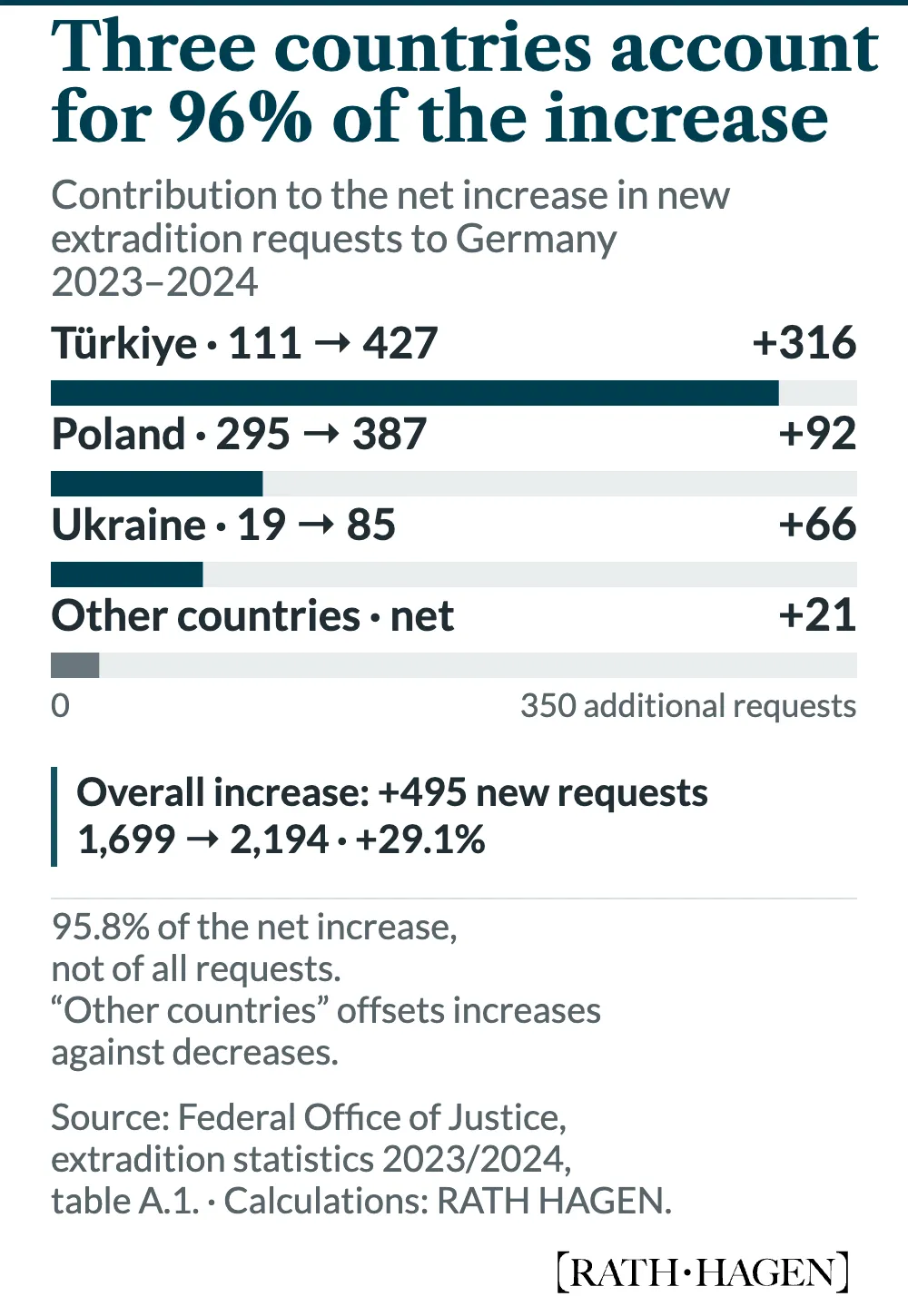
The rise is therefore concentrated in particular bilateral relationships. Understanding why Germany receives more extradition requests requires looking closely at what has changed in its dealings with those three countries.
2. Turkish requests are rarely approved
Türkiye’s 427 new requests in 2024 put it ahead of Poland’s 387. Its new requests had almost quadrupled from 111 the previous year.
The Turkish proceedings completed in 2024 produced 21 approvals, 127 refusals and 13 other disposals. The approval rate was 13.0%. Those decisions may concern older requests; they are not the outcomes of the 427 new requests.
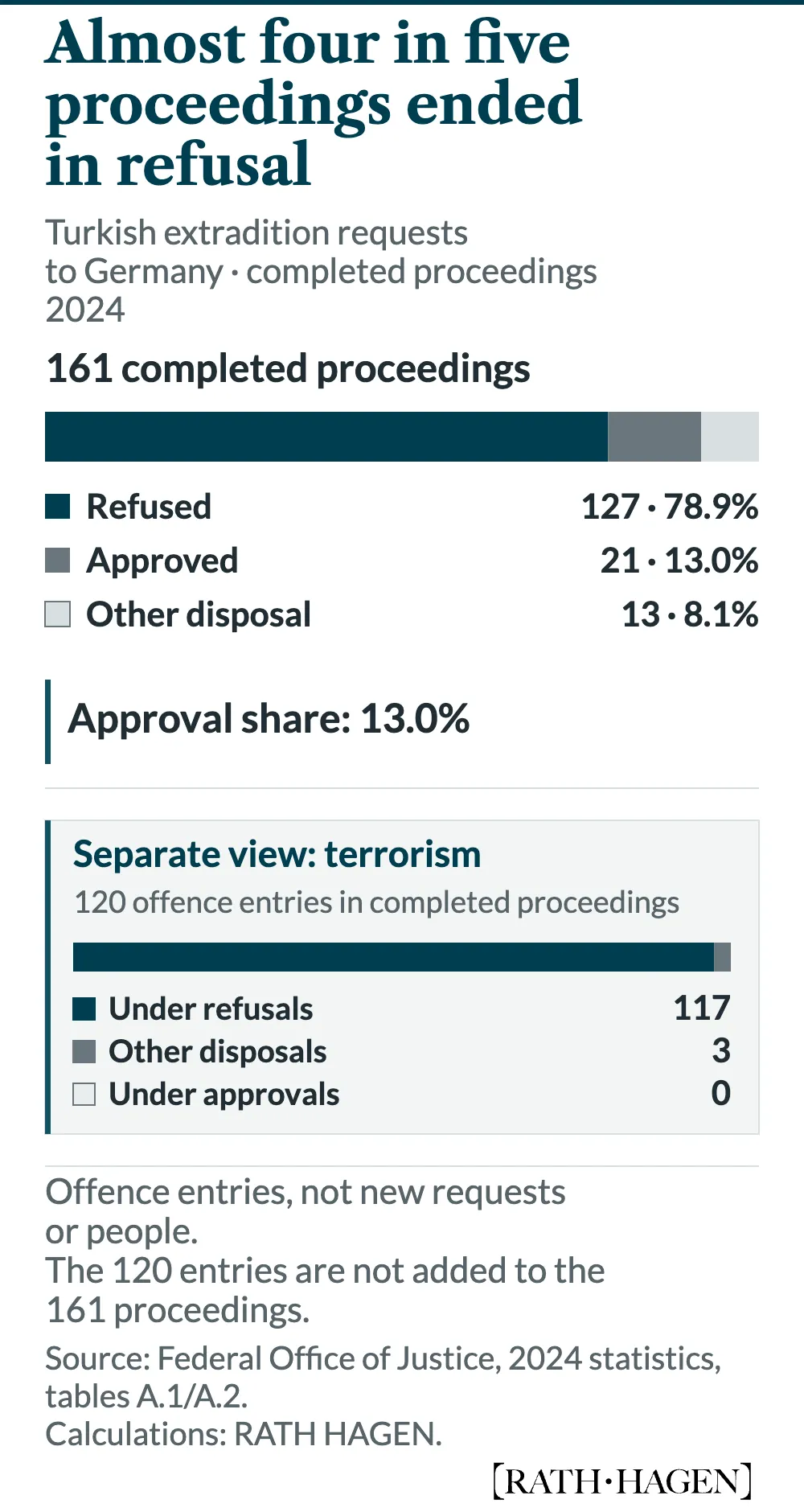
The terrorism category is particularly striking. For Türkiye, the statistics record 120 offence entries relating to completed proceedings: 117 under refusals, three under other disposals, and none under approvals. A serious allegation therefore does not automatically lead to approval. These figures establish neither the merits of the allegations nor the grounds for refusal. Understanding why extradition on these allegations was so often refused would require examining the decisions themselves.
3. Half of foreign requests concern sentences already imposed
Of the 2,194 new foreign requests to Germany in 2024, 1,101 concerned sentence enforcement. About half therefore sought enforcement of a sentence already imposed. The remaining 1,093 concerned prosecution.
Germany’s own requests to other states overwhelmingly concerned prosecution: 1,128 of 1,332 new requests, or 84.7%. Only 204 concerned sentence enforcement.
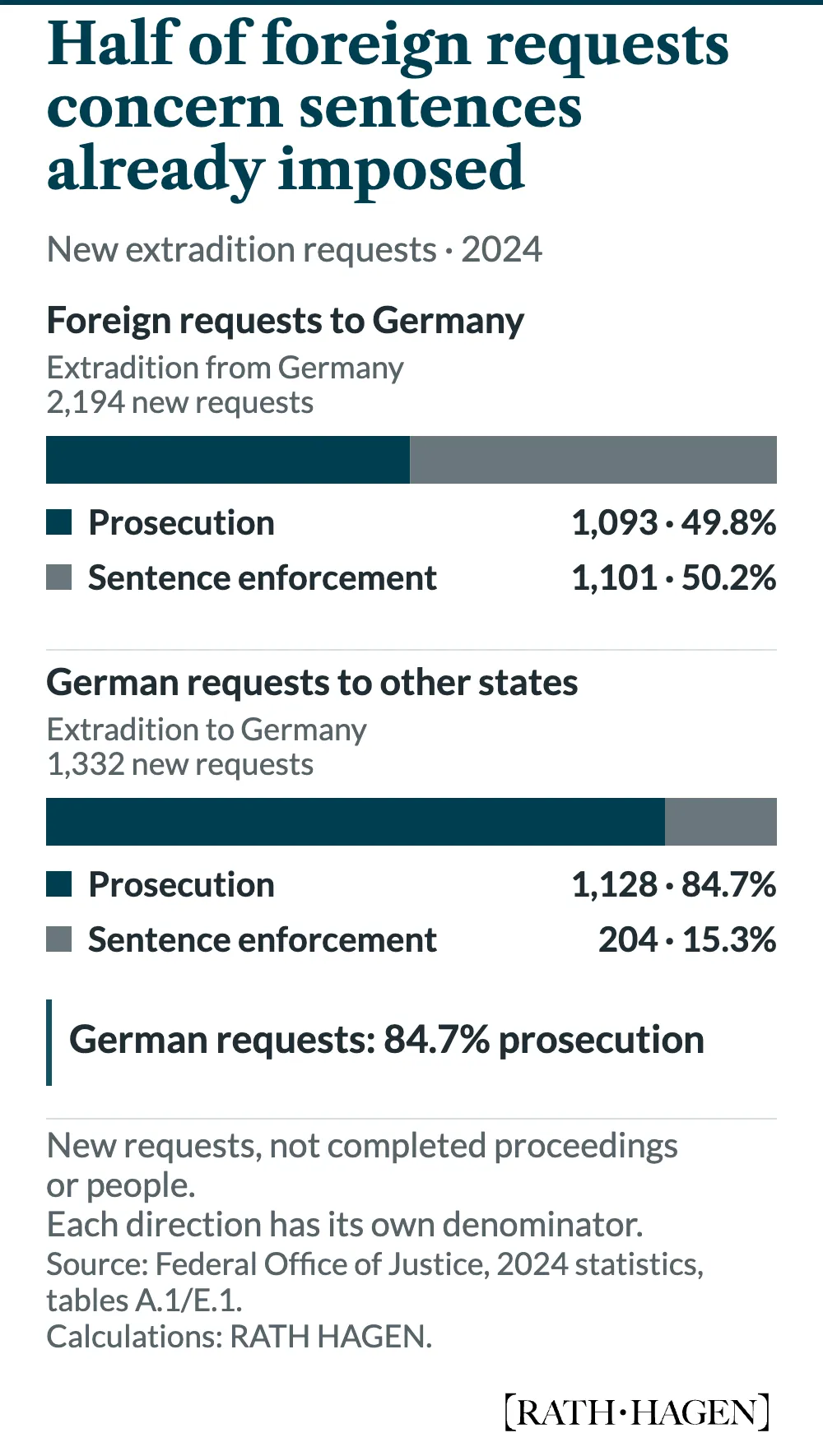
The word “extradition” therefore covers quite different defence tasks. A sentence-enforcement request calls for scrutiny of the foreign conviction. A prosecution request puts the allegation and ongoing proceedings at the centre of the work. A single overall approval rate conceals that distinction.
4. Almost half of approvals involve consent
The statistics record 746 approvals with consent and 798 based on a court decision in 2024. Consent accounted for 48.3% of these two approval categories. The proportion has risen in recent years, from 40.9% in 2022 to 44.4% in 2023.
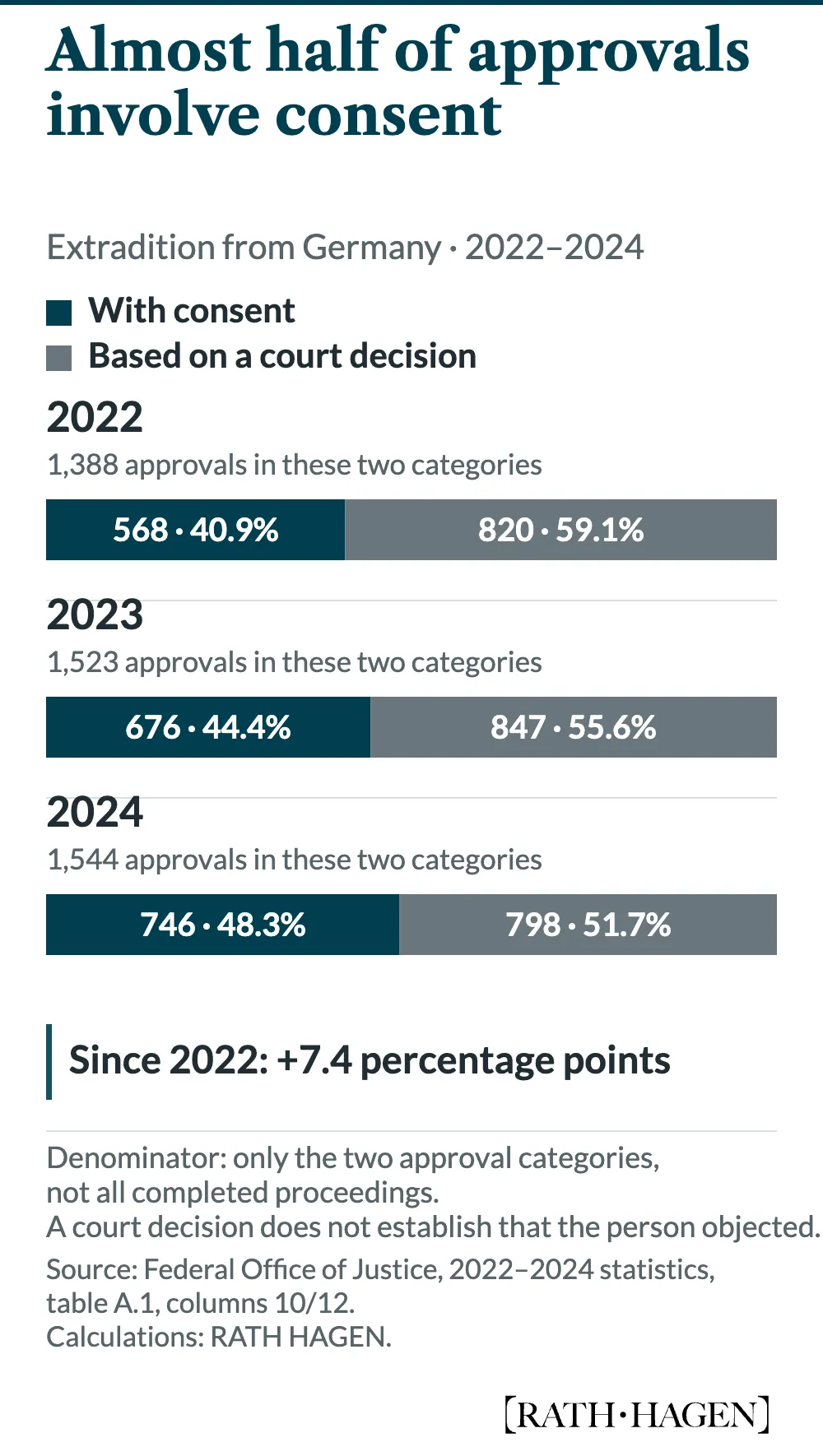
Consent cannot be withdrawn. Under section 41(3) of Germany’s Act on International Mutual Assistance in Criminal Matters (IRG), this applies to valid consent to simplified extradition recorded before a judge.
How often people consent says nothing about whether consent is advisable in a particular case. That requires understanding the proceedings awaiting them in the requesting state and the available objections to extradition. The statistics do not record their reasons for consenting.
5. Ukrainian requests rise; no Russian approvals were recorded in 2023 or 2024
New Ukrainian requests rose from six in 2022 to 19 in 2023 and 85 in 2024. In 2024, 14 approvals were recorded across 28 completed proceedings: half of the total. At year-end, 90 requests remained pending.
Russia moved in the other direction. Its new requests fell from eight to three to two over the same period. The statistics record no approvals for 2023 or 2024, compared with four in 2022.
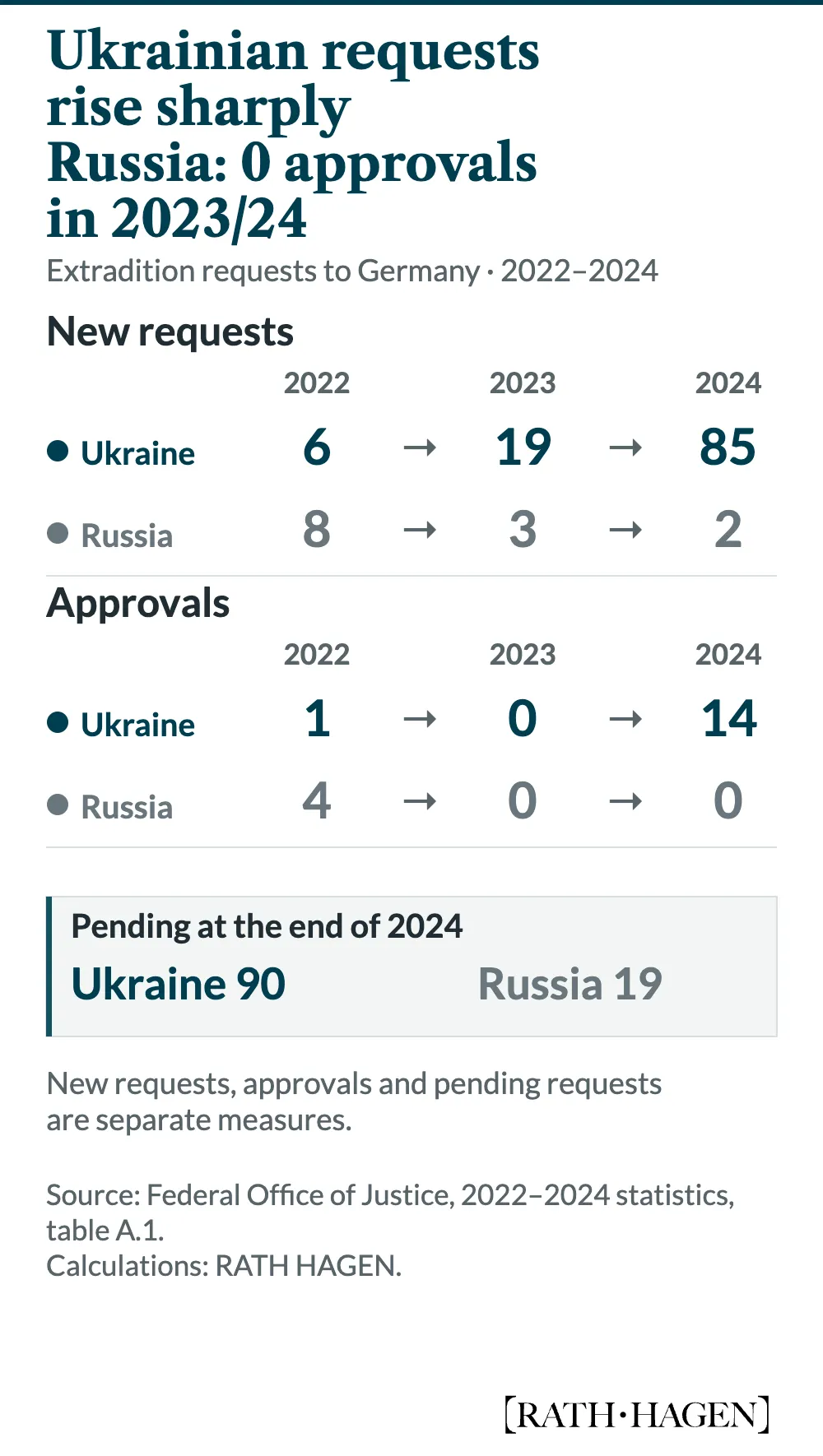
The figures show sharply diverging developments, but not their causes. Ukraine’s pending caseload says nothing about the number of people detained or the length of proceedings.
6. Germany’s requests abroad are approved more often than requests to Germany
Germany’s requests to other countries seek extradition to Germany. The statistics record 1,393 approvals across 1,563 completed proceedings in 2024: 89.1%.
Foreign requests to Germany seek extradition from Germany. These produced 1,544 approvals across 2,097 completed proceedings: 73.6%.
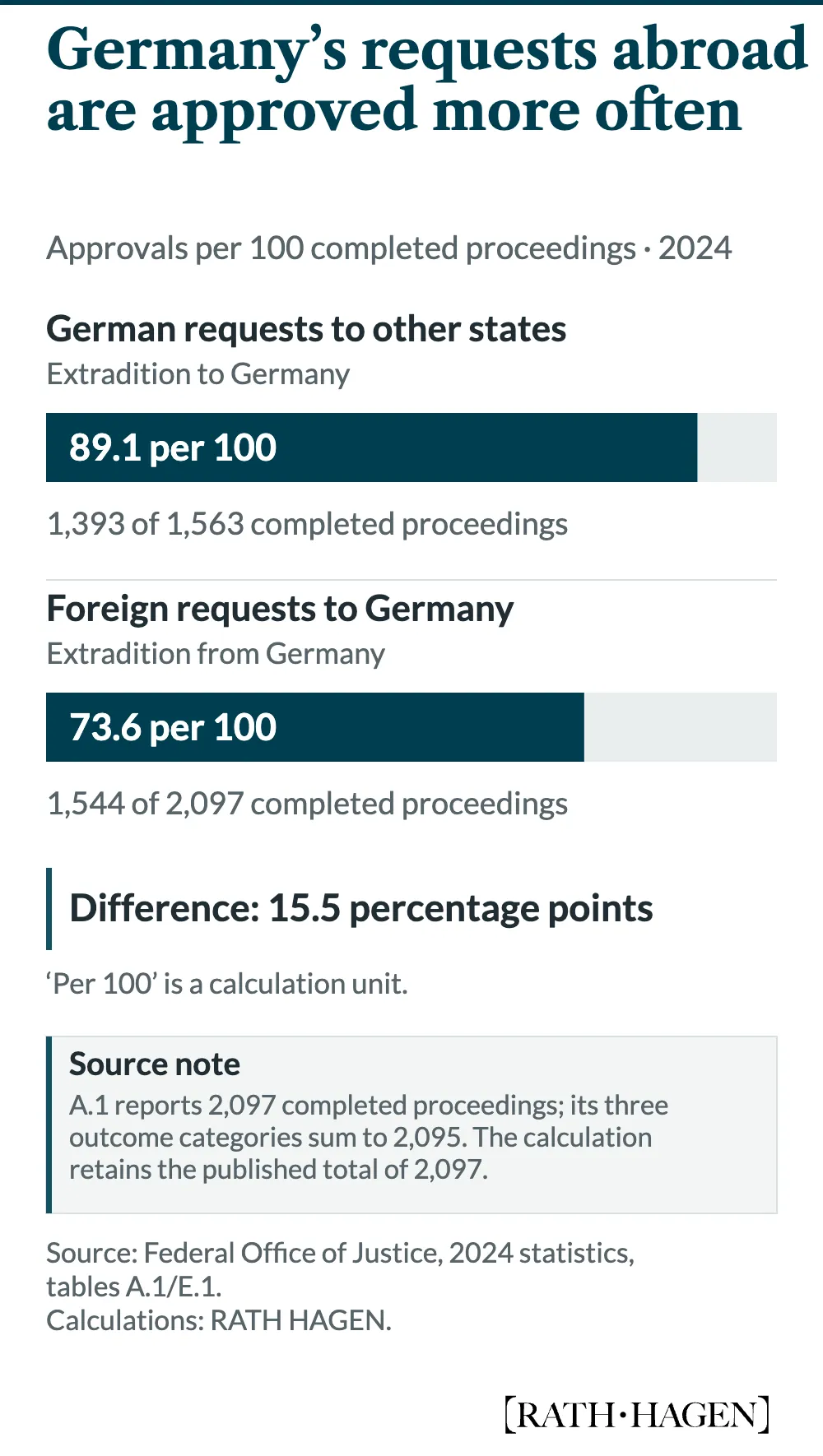
Germany’s requests abroad ended in approval more often than foreign requests to Germany. Per 100 completed proceedings, there were about 89 approvals for extradition to Germany and 74 for extradition from Germany; the gap was 15.5 percentage points. The case groups differ by country of origin and purpose, so the statistics do not explain the cause of the gap.
7. Refusal rates among major EU partners range from 2% to 27%
Outcomes vary considerably even among major EU partners. Of 424 Polish proceedings completed in 2024, 113 ended in refusal: 26.7%. For Austria, there were two refusals in 102 completed proceedings, or 2.0%. Italy stood at 20.8%, Romania at 14.3% and Hungary at 11.7%.
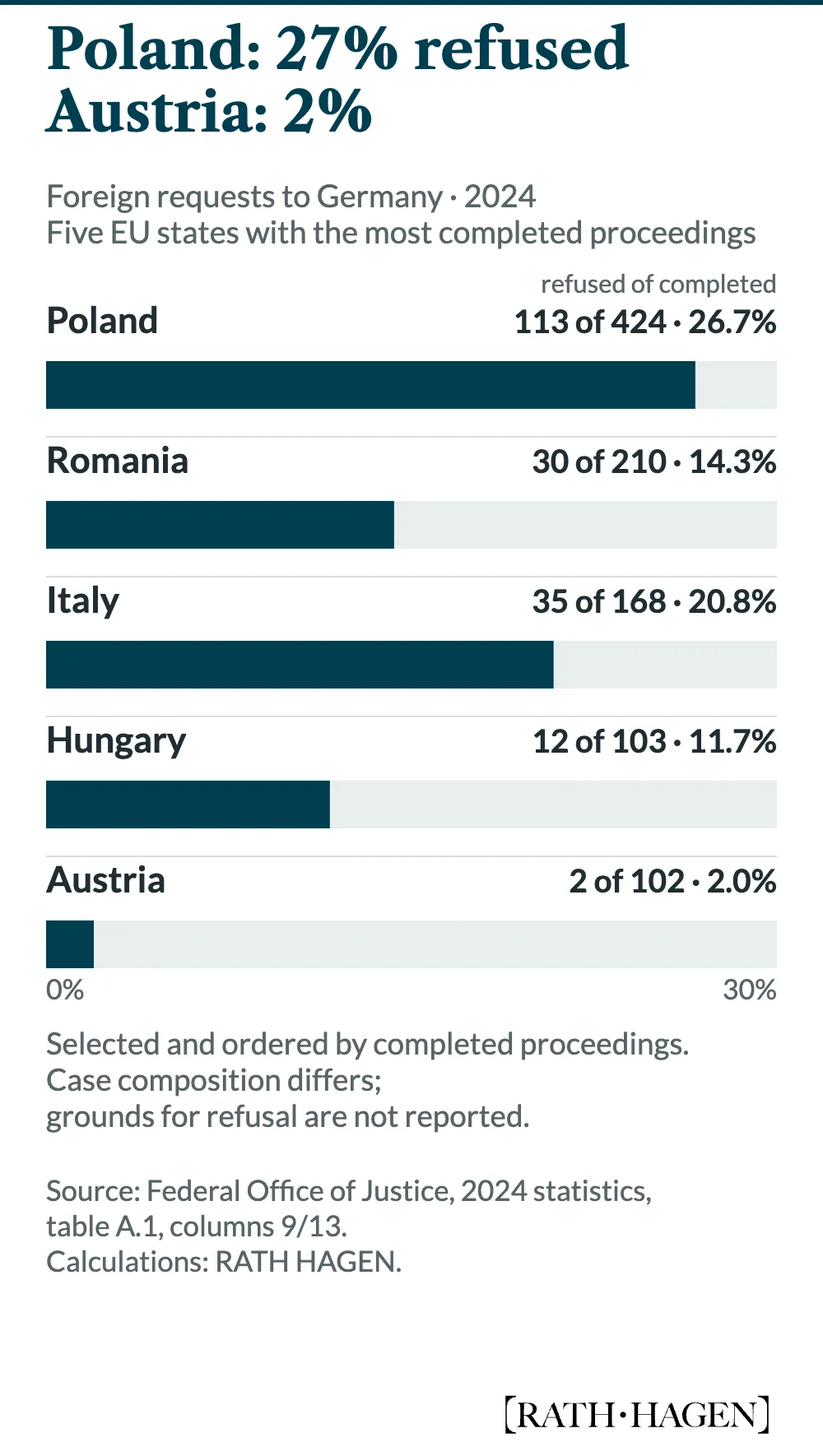
The countries were selected by the number of completed proceedings. The table does not show which case types or refusal grounds explain the differences, and it does not identify EAW cases separately.
Further analysis: Where extradition requests are approved most often
A second comparison identifies the ten countries with the highest approval rates in 2020–2024. It covers the 29 countries with at least 50 completed proceedings over those five years. Luxembourg leads with 96.6%, followed by Denmark and Sweden, both at a rounded 94.9%. For Luxembourg, that means 86 approvals across 89 completed proceedings.
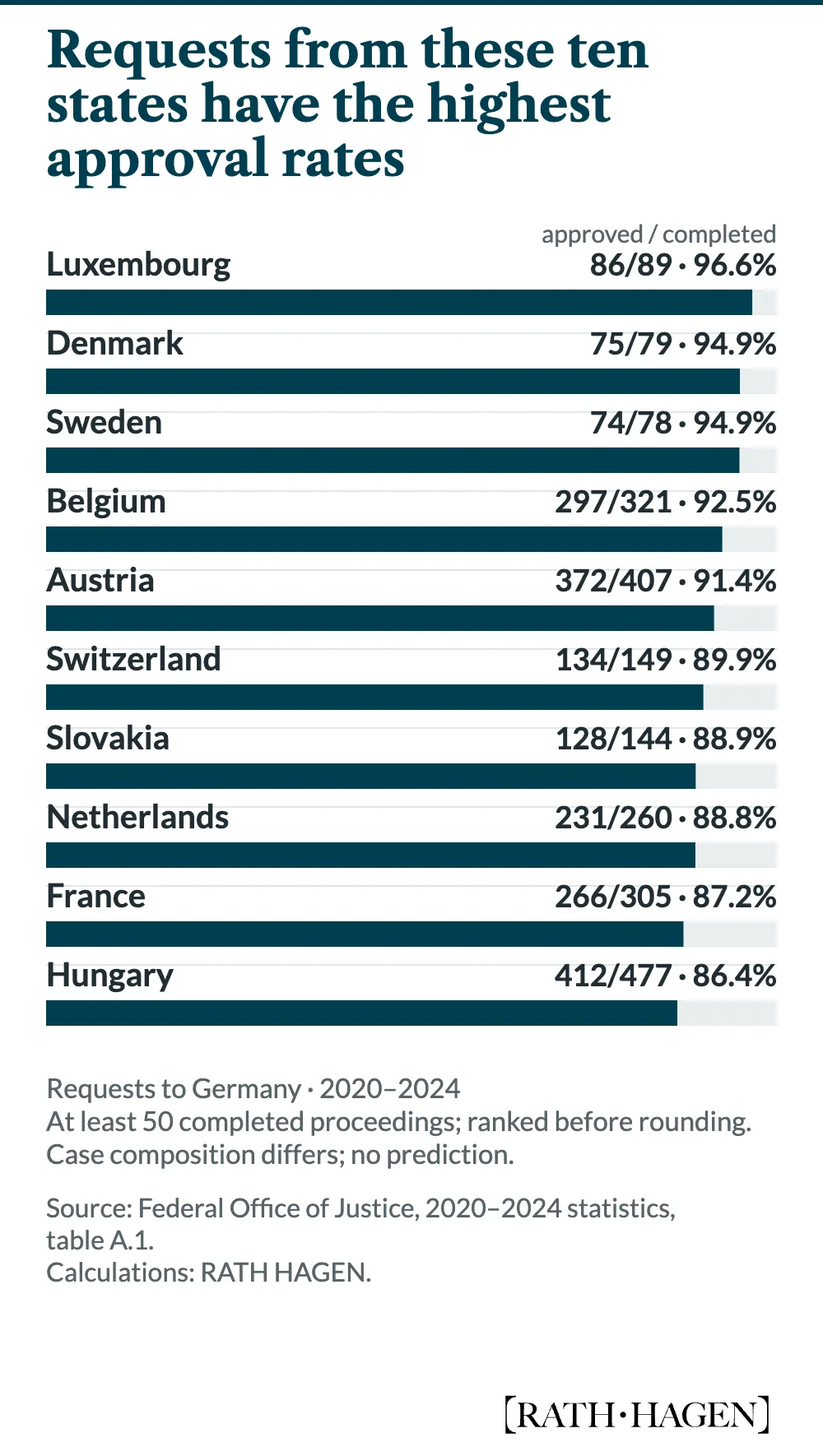
The minimum of 50 completed proceedings prevents isolated cases from producing a top ranking. The ranking describes past case groups; it does not predict the outcome of a new request.
8. EAW refusals: Trials in absentia move to the fore
The statistics on the European Arrest Warrant (EAW) add something missing from Germany’s country tables: recorded grounds for refusal. In 2020, Germany reported 66 entries under trials in absentia and 73 under the category expressly labelled “fundamental rights”. In 2024, the corresponding figures were 111 and 29.
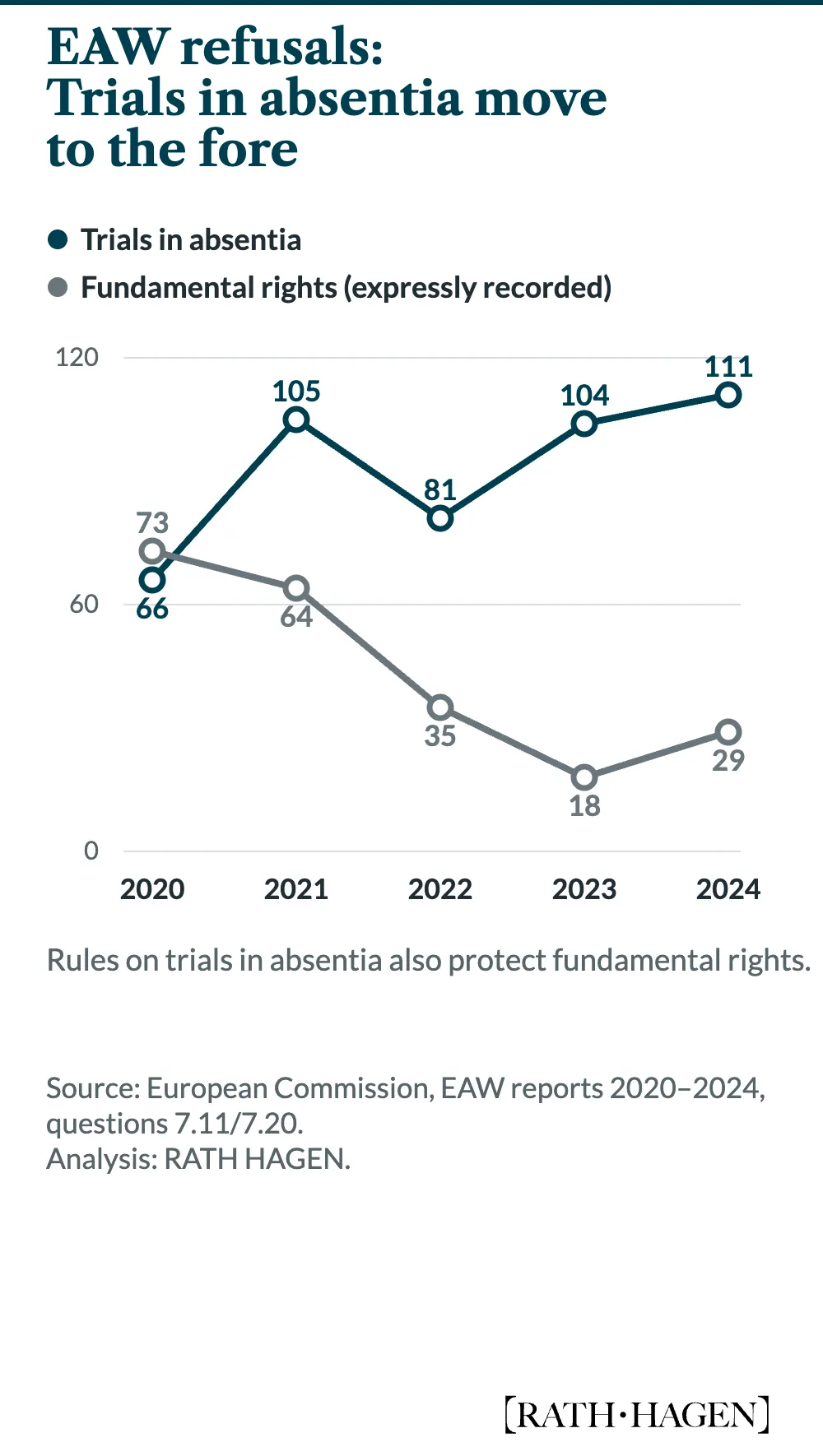
The pattern is uneven: entries under the category expressly labelled “fundamental rights” rose from 18 to 29 in the latest year. Rules on trials in absentia also protect fundamental rights. The decline therefore does not show that fundamental-rights protection has become less important.
For the defence, they highlight a concrete question: Did the convicted person have an effective opportunity to defend themselves against the allegation? Under section 83 IRG, relevant matters in cases involving judgments in absentia can include knowledge of the hearing, actual representation by counsel and an opportunity for a fresh examination of the merits. These questions require records from the underlying proceedings; a country’s approval rate cannot answer them.
Method and sources
The analysis uses tables A.1 and E.1 of Germany’s extradition statistics for 2022–2024, plus table A.2 for the Turkish terrorism entries in 2024. The additional ranking in section 7 sums annual A.1 figures for 2020–2024 (at least 50 completed proceedings per country; ranked before rounding). The focus is 2024. New requests, completed proceedings, pending requests and offence entries are kept separate. Approval and refusal rates use published totals for completed proceedings; the consent percentage uses the two approval categories. Percentages are our calculations, rounded to one decimal place. Multiple counting is possible: these are neither counts of people nor individual prospects of success. In A.1 for 2024, the outcome categories sum to 2,095 while the total column gives 2,097; we retain the published total.
The EAW comparison uses only Germany’s annual answers to questions 7.11 and 7.20 for 2020–2024. Several grounds may relate to the same refusal. The two categories do not cover every aspect of fundamental-rights protection, and no change in recording practice is inferred.
Source material: German extradition statistics 2024, BAnz AT 06.05.2026 B6, 2023, BAnz AT 08.07.2025 B5, 2022, BAnz AT 26.03.2024 B7. For the ranking, also see 2021, BAnz AT 09.03.2023 B6 and 2020, BAnz AT 28.03.2022 B5. Select the Federal Office of Justice notice on each daily index. The European Commission provides the EAW annual reports for 2020–2024 here; the 2024 report is also available directly as a PDF.