
Extradition from Germany to Poland
Defence against a Polish arrest warrant
German representation when Poland seeks your surrender
Poland is an EU member state. Surrender between Germany and Poland therefore generally takes place under a European Arrest Warrant.
We obtain the German extradition file, examine the Polish request and prepare submissions to the competent prosecution authority and Higher Regional Court (Oberlandesgericht). We handle German extradition proceedings throughout Germany. Where representation in Poland is needed, we identify and coordinate suitable local lawyers.
After an arrest: If known, tell us where the person is being held, the authority involved and the case reference. Keep complete court documents. Obtain legal advice before consenting to simplified surrender or waiving the rule of speciality.

Polish detention conditions and the 2026 court decisions
Surrender must not expose a person to a real risk of inhuman or degrading detention conditions. In Polish cases, a particular issue in 2026 is whether a German court can adequately address that risk by restricting the choice of prison, and how compliance with that restriction can be secured.
On 13 May 2026, the Higher Regional Court of Schleswig ruled that surrender to Poland was inadmissible. Reports by Poland’s National Preventive Mechanism (KMPT) had raised concerns about systemic deficiencies in the prison system. In that case, the Polish authorities’ general statement that detention would comply with human-rights standards did not satisfy the court. OLG Schleswig, 1 OAus 10/26
In a separate case, the Higher Regional Court of Hamm allowed surrender on condition that detention take place in specified prisons. On 11 August 2026, Germany’s Federal Constitutional Court temporarily stopped the handover. Whether Poland would comply required further examination: its Justice Ministry had declined to give a prison-specific assurance in another case. This interim order did not finally determine whether surrender was lawful. Nor did it end extradition detention. Federal Constitutional Court, 2 BvR 1502/26
We establish the proposed prison for pre-trial detention or sentence enforcement, how current the evidence before the German court is and whether assurances cover later transfers. For clients with medical conditions, we use medical records to establish the treatment needed and examine whether it is actually available. Neither Poland’s EU membership nor an outdated report concerning a different prison answers these questions.
Convictions in absence: notice and effective defence
Absence from the relevant Polish hearing may provide a ground for refusing surrender under section 83 IRG. However, the Act contains exceptions, including timely official notice of the hearing and the required warning, authorising a lawyer with knowledge of the hearing and being effectively represented by that lawyer, or a guaranteed right to fresh proceedings in which the merits can be reconsidered. Preventing personal service by absconding may also be treated differently where a defence lawyer was involved. Section 83 IRG
A Brandenburg case illustrates why the underlying records matter. The European Arrest Warrant stated that the defendant had been personally summoned to the Polish hearing. In fact, he was in pre-trial detention in Germany that day. He had no lawyer representing him at the hearing in Poland, and further enquiries established that no qualifying right to fresh proceedings was available. The Higher Regional Court held surrender inadmissible and lifted the extradition detention warrant. Decision of 7 August 2023 – 1 OAus 1/23 (2)
We compare the European Arrest Warrant with the judgment, summons and service records, and any German custody records. If the operative judgment was delivered on appeal, we also examine the appeal proceedings. With Polish counsel, we establish which remedies remain available and whether they allow a fresh examination of the merits. Absence alone, or a theoretical possibility of reopening the case, does not provide a reliable answer.
A Polish sentence when your life is established in Germany
Many Polish requests concern sentences already imposed. Germany’s 2024 extradition statistics record 387 new requests from Poland, of which 310, approximately 80%, sought sentence enforcement. Living in Germany does not by itself prevent surrender. 2024 extradition statistics, table A.1
For a foreign national habitually resident in Germany, the authorities may refuse to authorise surrender for sentence enforcement if, after judicial advice, the person does not consent and their legitimate interest in serving the sentence in Germany prevails. A central consideration is where rehabilitation after imprisonment is more likely to succeed. We therefore document the person’s actual family, work and social ties to Germany and Poland. An entry in the residents’ register does not establish the whole picture. Section 83b(2), no. 2, IRG
Useful evidence may include records of living with children, work actually undertaken and a settled pattern of residence. At the same time, the conditions under which Germany could take over enforcement of the Polish judgment need to be assessed. Refusing surrender does not set aside the Polish conviction.
Additional protection for German nationals
A German national may be surrendered to enforce a Polish sentence only if they consent, following judicial advice, in a statement recorded by a judge. Different conditions apply to surrender for prosecution. These include an assurance that, following a final conviction, Poland will offer to transfer the person back to Germany to serve the sentence if they wish, and an assessment of the offence’s connection with Germany or Poland. German nationality must therefore be considered alongside the purpose of the warrant and the alleged conduct. Section 80 IRG
Concerns about the independence of Polish courts
The case law on Poland’s judiciary does not create a blanket ban on surrender. The Court of Justice of the European Union requires an assessment of both general or systemic deficiencies and concrete indications that the person’s right to an independent, impartial tribunal established by law would be infringed. Where a conviction already exists, the court that decided the case must be examined; where prosecution is still ahead, the assessment concerns the risk the individual would face. CJEU, judgment of 22 February 2022 – C-562/21 PPU and C-563/21 PPU
Such an objection requires current information specific to the criminal case, for example about the composition of the court and the appointment of its judges. We assess what can be substantiated and what additional information should be requested in the German surrender proceedings.
A German arrest warrant when you are in Poland
When Germany seeks surrender from Poland, the Polish judicial authorities decide whether to execute the European Arrest Warrant. According to the European Judicial Network’s country information, the request is handled through the competent regional prosecution office, and the competent circuit court decides on detention and surrender. The European Arrest Warrant must be translated into Polish. EJN country information for Poland, reviewed 1 April 2026
RH handles the German criminal defence and examines the German warrant. Local counsel deals with the surrender proceedings in Poland. We coordinate the two, including where an application to revoke the German warrant or suspend its execution may be appropriate. Whether that is possible depends on the evidence supporting the allegation, the grounds for detention and the stage of proceedings. Any change to the warrant must also be reflected in the associated alerts.



Frequently asked questions about extradition to Poland
Polish extradition requests in figures
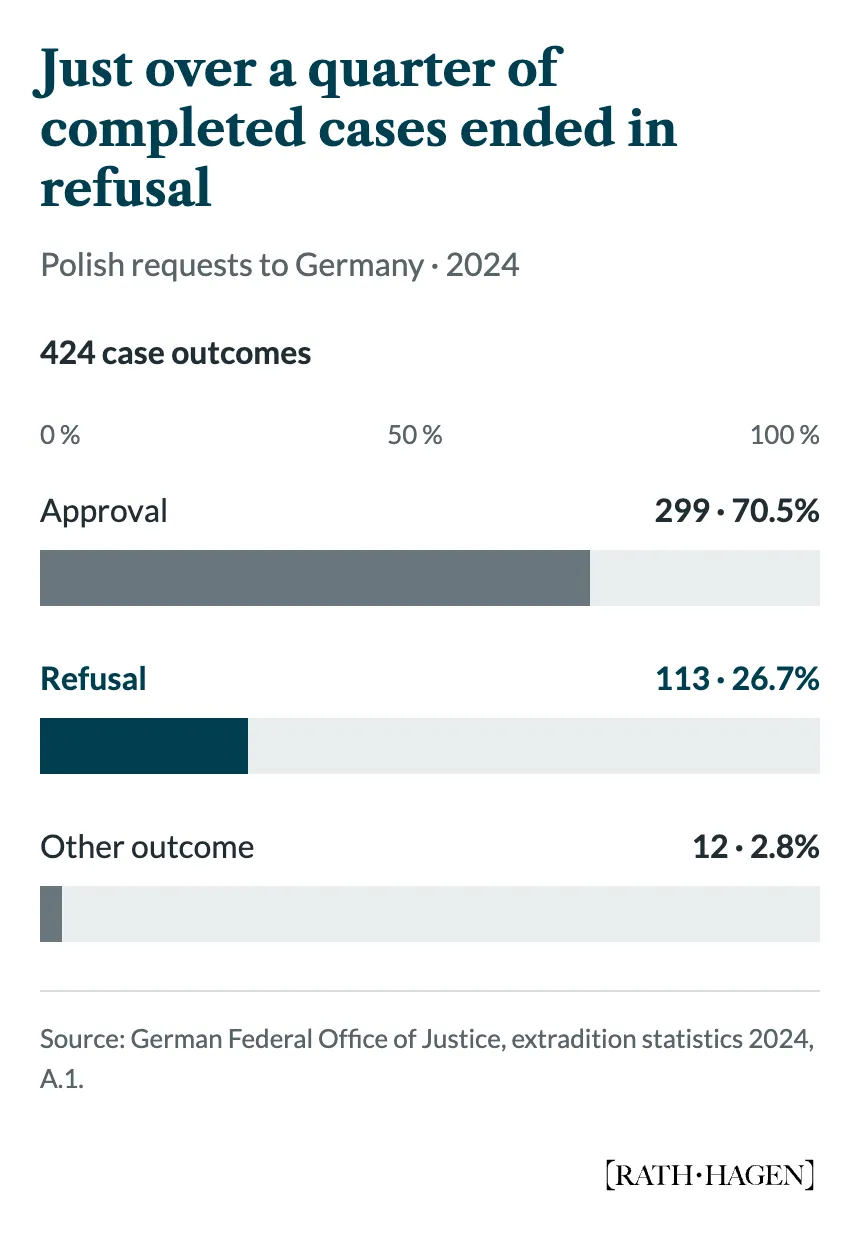
Germany recorded 424 outcomes of Polish extradition requests in 2024: 299 approvals, 113 refusals and 12 other outcomes. The approval rate was 70.5% and the refusal rate 26.7%.
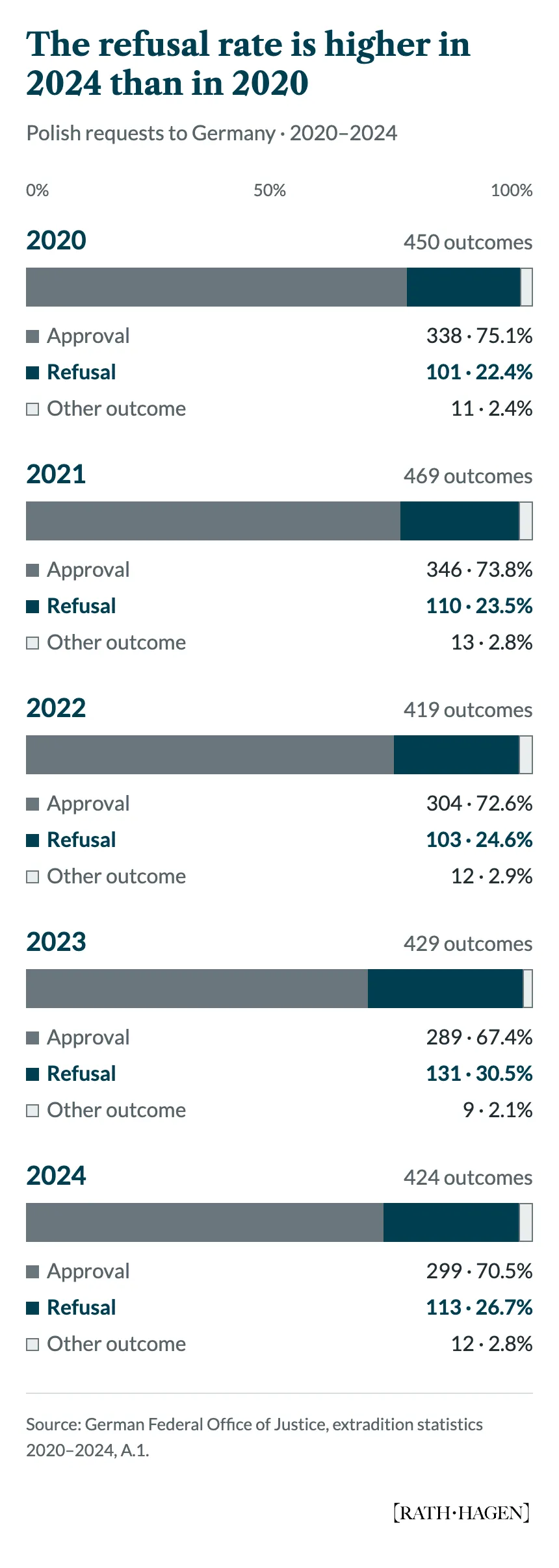
Approvals and refusals since 2020
The refusal rate rose from 22.4% in 2020 to 26.7% in 2024. The highest rate during this five-year period was 30.5% in 2023. The approval rate was 75.1% in 2020 and 70.5% in 2024.
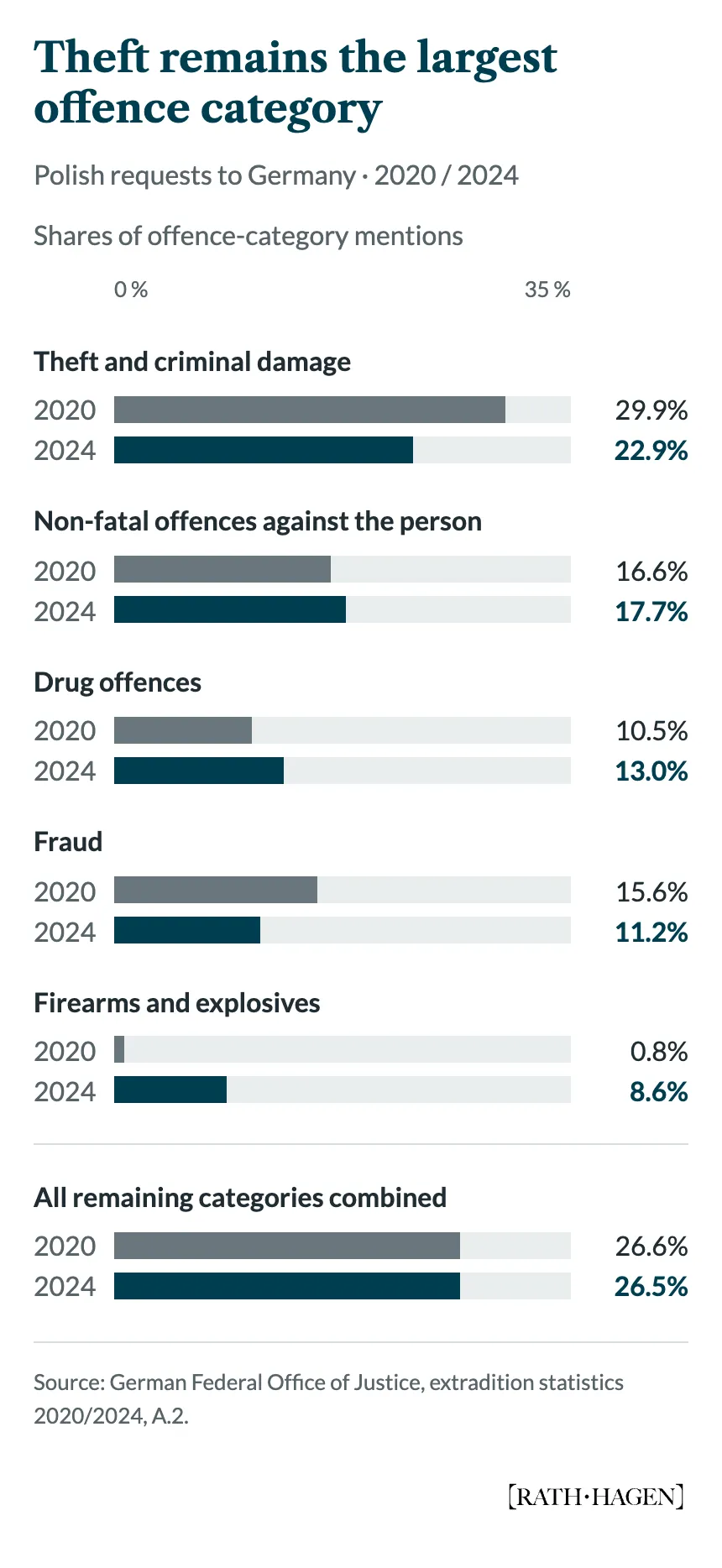
The most frequently reported offence categories
Theft and criminal damage formed the largest specific category in 2024, accounting for 22.9% of offence-category mentions. It was followed by non-fatal offences against the person at 17.7%, drug offences at 13.0% and fraud at 11.2%. Firearms and explosives accounted for 8.6%.
Send Us a Message
Fill out the form below and one of our attorneys will contact you to discuss your legal matter.