
Extradition from Germany to Turkey
Defence against Turkish arrest warrants
German representation when Turkey seeks your extradition
Extradition from Germany to Turkey is governed by the European Convention on Extradition and the applicable additional protocols, supplemented by Germany’s International Mutual Assistance in Criminal Matters Act (IRG). As an INTERPOL member, Turkey also uses Red Notices to seek wanted persons internationally.
We act in German extradition proceedings nationwide, obtain the case file and prepare submissions to the competent prosecution authority and Higher Regional Court (Oberlandesgericht). For Turkish requests, we examine the background to the prosecution, any refugee status and assurances concerning detention or a retrial. Where representation in Turkey is needed, we identify and coordinate suitable lawyers in Turkey.
After an arrest, seek legal assistance promptly. If known, have the place of detention, the authority involved and the case reference ready, and keep complete copies of court documents. Before consenting to simplified extradition or waiving the protection of the rule of speciality, obtain advice on the legal consequences.

Political persecution behind a Turkish criminal allegation
Where a Turkish request concerns alleged PKK or Gülen links, the assessment must address whether the person faces persecution or adverse treatment in the criminal proceedings because of their political beliefs. Serious grounds for believing that such a risk exists bar extradition. Section 6 IRG also generally prohibits extradition for political offences. Exceptions for certain serious violent offences require a specific account of the alleged conduct; describing it as terrorism is insufficient.
The Karlsruhe Higher Regional Court applied this requirement to a request concerning a former PKK member. He was alleged to have transported weapons, but the alert did not establish which weapons were involved or whether anyone had been endangered. Those omissions left the court unable to establish whether an exception to the prohibition on extradition for political offences applied. It therefore had substantial doubts as to whether the alleged offence could support extradition at all.
ByLock use features prominently in criminal cases against alleged members of the Gülen movement. ByLock is an encrypted messaging app that Turkish courts regarded as a means of communication used by FETÖ/PDY, which they classified as a terrorist organisation.
In Yüksel Yalçınkaya, the conviction for membership of an armed terrorist organisation rested decisively on use of the app. The European Court of Human Rights criticised the largely automatic inference of membership, without an individual assessment of the material and mental elements of the offence. The defendant also lacked adequate opportunities to challenge the underlying ByLock data. In these respects, the Court found violations of the principle of no punishment without law and the right to a fair trial.
The Council of Europe memorandum published in May 2026 continues to describe the broad use of criminal and anti-terrorism laws against peaceful expression and shortcomings in judicial independence. In extradition proceedings, the decisive question is whether those findings create a specific risk of persecution or an unfair trial for the person concerned.
Refugee recognition can prevent extradition
Refugee recognition granted by another EU member state also binds the German extradition authorities. While that status remains in force, a Turkish national cannot be extradited to their country of origin. The Court of Justice of the European Union confirmed this in a case involving a Turkish request concerning a killing. Even an allegation of that kind does not allow Germany to disregard the protection granted. The German authorities must consult the authority in the recognising member state; any decision to withdraw refugee status rests with that state.
Prison conditions and medical care must be secured
The European Commission’s November 2025 report on Turkey describes overcrowded prisons, inadequate living conditions and shortcomings in access to healthcare. Extradition proceedings must, however, focus on the designated prison, including occupancy, personal space, hygiene and medical care. The decisive issue is whether the person would face inhuman or degrading treatment there.
Assurances from the Turkish authorities must be sufficiently specific and reliable in the individual case. In the proceedings before the Brandenburg Higher Regional Court, the assurances identified the proposed prison, promised conditions complying with Article 3 ECHR and allowed visits by Germany’s diplomatic or consular mission. The court accepted this combination of a specific detention commitment and an opportunity to monitor compliance.
For a person with a medical condition, the promised care must meet their individual treatment needs. Germany’s Federal Constitutional Court criticised a decision involving a documented suicide risk because the Higher Regional Court had not adequately investigated the health risks or the suitability of the safeguards. The assessment must cover both the transfer and subsequent detention. Medical evidence must identify the required treatment and protective measures and the consequences of any interruption.
Convictions in absence and the right to a retrial
A person convicted in their absence must have had an effective opportunity to defend the allegation. The extradition court must therefore establish whether they knew about the proceedings and could actually exercise their defence rights. If those safeguards were absent, extradition to serve the sentence may still be permissible where there is a binding guarantee of a new trial allowing a fresh examination of the merits with an effective defence.
The German court must establish that the promised reopening would genuinely allow the person to obtain a fresh decision on the merits. In a case concerning extradition to Turkey, the Federal Constitutional Court criticised the Higher Regional Court for accepting an assurance it had previously regarded as inadequate. It had also failed to establish whether the person had deliberately evaded the criminal proceedings or had fled for another reason. The decision thus requires an assessment of the actual opportunities for defence in both the original proceedings and any new trial.
Sentence enforcement and limitation periods require an offence-by-offence review
A Turkish request to enforce a sentence may cover several convictions whose penalties were subsequently aggregated. The individual judgments remain decisive: they must identify the offences, the final individual sentences and the parts still to be served after credit for time already spent in custody.
Limitation periods must likewise be determined for each sentence separately. If only one component sentence is time-barred, extradition may remain permissible for the other convictions. The Brandenburg Higher Regional Court therefore excluded a time-barred ten-month prison sentence from a request covering several aggregated sentences.
A sentence substantially longer than would be usual in Germany does not by itself prevent extradition. Extradition may be impermissible if, in the circumstances of the individual case, the sentence is intolerably harsh and disproportionate under any view. Relevant factors include the gravity of the offences, individual responsibility and actual enforcement, including credit for time served and any prospect of early release.
German nationality and family ties in Germany
Article 16(2) of the Basic Law bars the extradition of German citizens to Turkey. This also applies to people who hold both German and Turkish nationality. The constitutional exception allowing extradition to EU member states does not extend to Turkey. A German residence permit or many years living in Germany does not provide the same protection as citizenship.
Family relationships and particular dependencies may be relevant to the assessment, but do not by themselves prevent extradition. Evidence should explain the actual arrangements, for example caring for young children or a dependent relative.
A German arrest warrant while you are in Turkey
Following an arrest in Turkey under a German warrant, the warrant can be reviewed in Germany; the Turkish extradition proceedings require a lawyer admitted there. Article 38 of the Turkish Constitution generally bars extradition of Turkish nationals for an offence. That does not dispose of the German criminal proceedings; mutual legal assistance and the consequences of travel to third countries require separate consideration.
Frequently asked questions about extradition to Turkey




Turkish extradition requests in figures
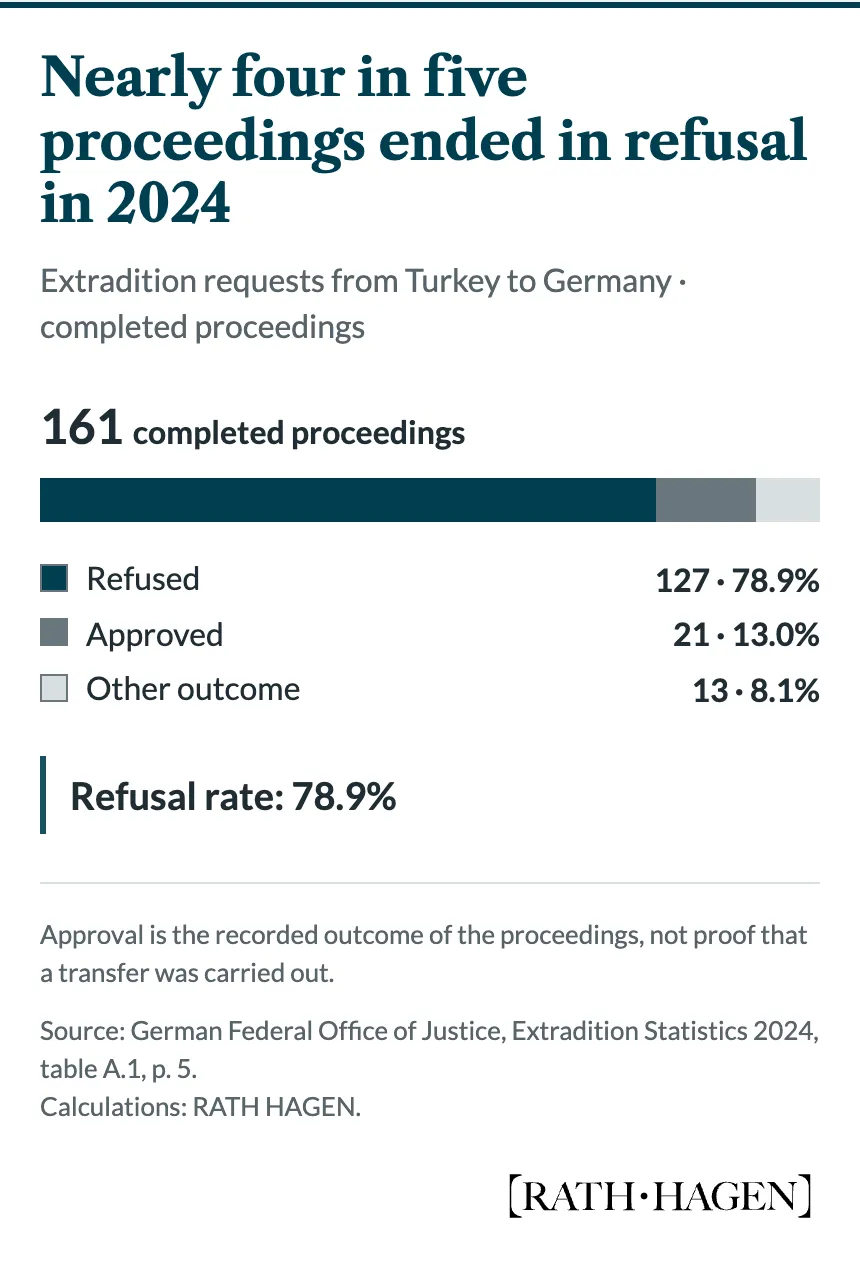
Germany recorded 161 outcomes of Turkish extradition requests in 2024: 127 refusals, 21 approvals and 13 other outcomes. The refusal rate was 78.9% and the approval rate 13.0%.
Sharp increase in new requests in 2024
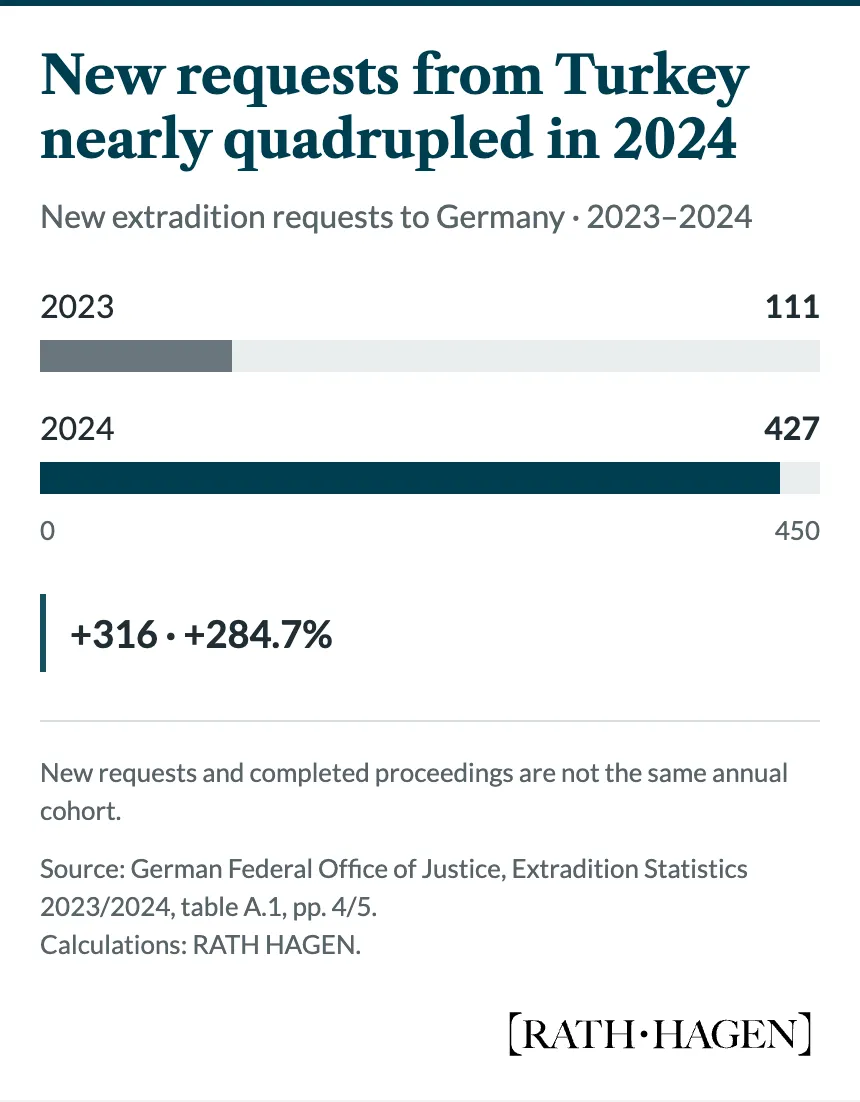
New requests from Turkey to Germany rose from 111 in 2023 to 427 in 2024. This was an increase of 316 requests or 284.7%. New requests and completed proceedings are not the same annual cohort.
The most frequently reported offence categories
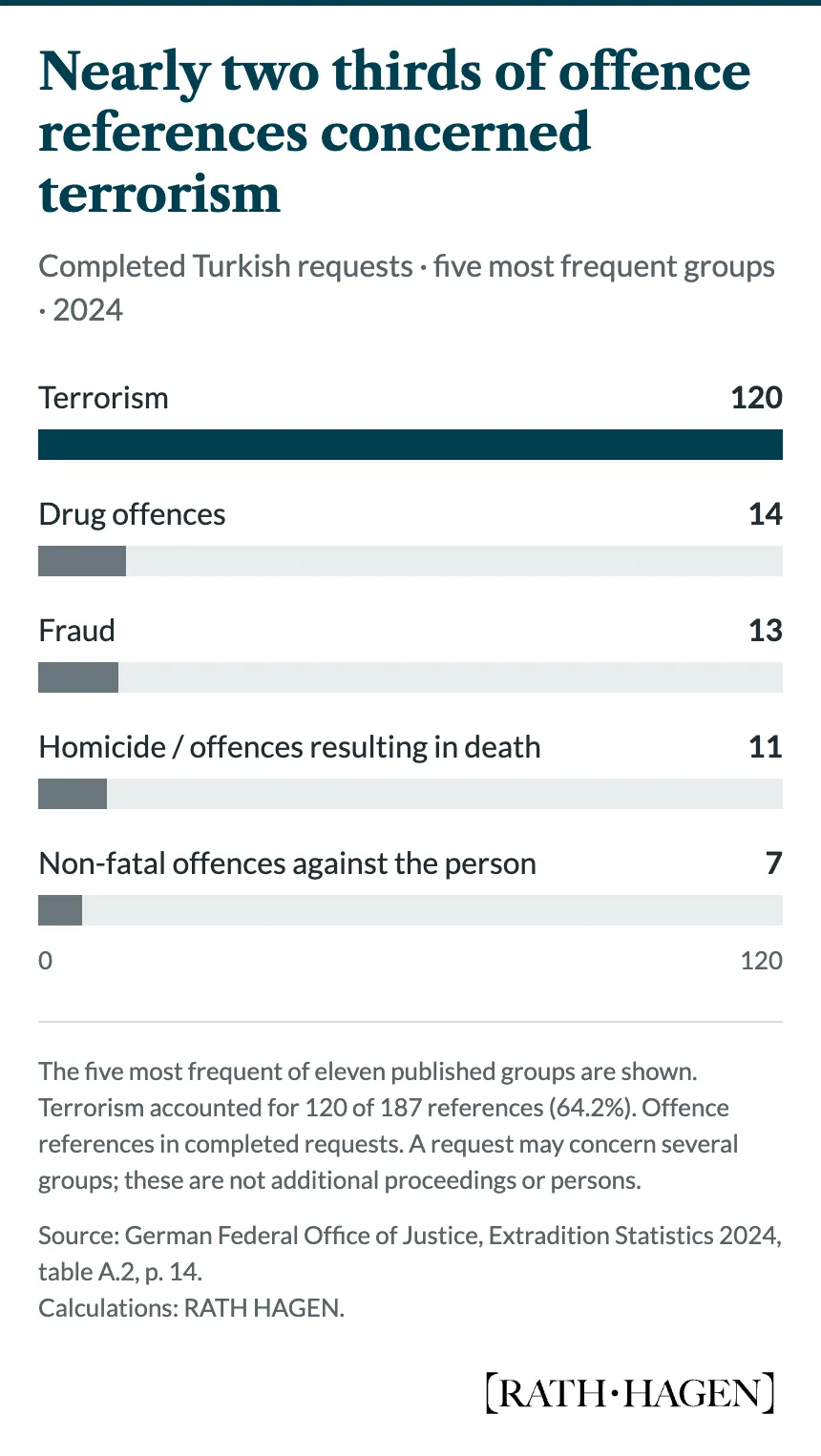
Terrorism was by far the largest category in 2024, with 120 of 187 published offence references. It was followed by drug offences with 14 references, fraud with 13, homicide or offences resulting in death with 11, and non-fatal offences against the person with 7.
Discuss an extradition case involving Turkey
Briefly explain whether an arrest has taken place or a warrant has come to light, and where the person concerned is located.